
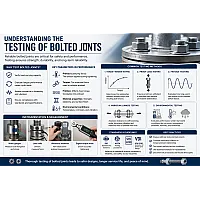
Understanding the Testing of Bolted Joints
Bolted joints are among the most widely used fastening methods in engineering, found in everything from bridges and aircraft to machinery and consumer products. Despite their apparent simplicity, ensuring their reliability requires careful testing and analysis. This post explores why bolted joint testing matters, the key methods used, and best practices for achieving dependable performance.
Why Test Bolted Joints?
A bolted joint’s primary function is to clamp components together with sufficient force to resist external loads. Failure can lead to catastrophic consequences—structural collapse, equipment malfunction, or safety hazards. Testing helps engineers:
Verify load-carrying capacity.
Evaluate fatigue performance under cyclic loads.
Assess resistance to loosening and vibration.
Ensure compliance with standards and specifications.
Key Parameters in Bolted Joint Performance
Before diving into testing methods, it’s important to understand the critical factors that influence joint behavior:
Preload (clamping force): The tension applied during tightening.
Torque: The rotational force used to achieve preload.
Friction: Affects how torque translates into preload.
Material properties: Strength, elasticity, and surface finish.
Environmental conditions: तापerature, corrosion, and vibration.
Common Testing Methods
1. Torque-Tension Testing
This test measures the relationship between applied torque and resulting bolt tension. Since friction can vary significantly, this test helps determine how much torque is needed to achieve the desired preload.
Procedure:
Apply torque using a calibrated wrench.
Measure resulting tension with load cells or strain gauges.
Plot torque vs. tension curve
2. Proof Load Testing
Proof load testing ensures that a bolt can withstand a specified load without permanent deformation.
Procedure:
Apply a predetermined tensile load.
Hold for a specified duration.
Check for elongation or failure.
3. Fatigue Testing
Bolted joints often experience repeated loading. Fatigue testing evaluates how long a joint can endure cyclic stresses before failure.
Procedure:
Subject the joint to cyclic loads.
Monitor for crack initiation and propagation.
Record number of cycles to failure.
4. Vibration (Junker) Testing
One of the most critical tests for bolted joints, this method assesses resistance to self-loosening under transverse vibration.
Procedure:
Apply cyclic shear loads perpendicular to the bolt axis.
Measure loss of preload over time.
Compare performance of different locking mechanisms.
5. Environmental Testing
Real-world conditions can degrade joint performance.
Examples:
Corrosion testing (salt spray).
High/low temperature exposure.
Humidity and chemical resistance.
Instrumentation and Measurement Techniques
Modern testing relies on precise instrumentation:
Strain gauges: Measure bolt elongation and stress.
Load cells: Directly measure force.
Ultrasonic methods: Non-destructive preload measurement.
Digital torque tools: Ensure accurate tightening.
Standards and Guidelines
Testing of bolted joints is guided by international standards, such as:
ISO standards for fasteners.
ASTM testing procedures.
VDI 2230 (a widely used German guideline for bolted joint design).
Adhering to these ensures consistency and reliability across industries.
Best Practices
Always calibrate tools and instruments.
Consider lubrication effects on torque-preload relationship.
Test under realistic service conditions.
Use statistical analysis for repeatability.
Document all procedures and results thoroughly.
Conclusion
Bolted joints may seem straightforward, but their reliability depends heavily on proper testing and validation. By understanding the mechanics involved and applying rigorous testing methods, engineers can ensure safe and durable designs. Whether in construction, automotive, or aerospace applications, investing in thorough bolted joint testing is essential for long-term performance and safety.