
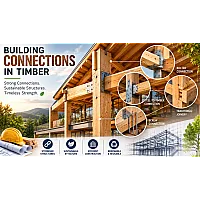
Building Connections in Timber: The Foundation of Strong and Sustainable Structures
Timber has been one of humanity's most trusted construction materials for centuries. From traditional wooden homes to modern engineered timber skyscrapers, the strength and durability of timber structures depend not only on the quality of the wood itself but also on the effectiveness of the connections that hold the components together. Building connections in timber is both an art and a science, requiring careful consideration of structural performance, aesthetics, durability, and constructability.
Why Timber Connections Matter
Timber members such as beams, columns, trusses, and panels are designed to carry loads efficiently. However, the points where these members meet—known as connections or joints—are often the most critical parts of the structure. A poorly designed connection can lead to excessive deformation, reduced load-bearing capacity, or even structural failure.
Effective timber connections serve several important functions:
Transfer loads safely between structural members.
Maintain stability under varying environmental conditions.
Accommodate movement caused by moisture changes and temperature fluctuations.
Enhance the overall durability and lifespan of the structure.
Contribute to the architectural appearance of the building.
Types of Timber Connections
Timber connections can be broadly categorized into traditional and modern systems.
Traditional Timber Joints
Traditional timber construction relies on carefully crafted wood-to-wood joints, including:
Mortise and tenon joints
Dovetail joints
Lap joints
Scarf joints
These connections have been used for centuries in timber framing and continue to be valued for their craftsmanship and aesthetic appeal. Although labor-intensive, they can provide excellent structural performance when properly designed and executed.
Mechanical Fasteners
Modern timber construction frequently employs mechanical fasteners to simplify assembly and improve structural reliability. Common fasteners include:
Nails
Screws
Bolts
Dowels
Timber rivets
Mechanical fasteners offer advantages such as faster installation, easier inspection, and predictable performance under load.
Steel-to-Timber Connections
In large-scale timber buildings, steel plates, brackets, and connectors are often integrated with timber elements. These hybrid connections combine the strength of steel with the sustainability and warmth of timber.
Steel-to-timber connections are particularly useful for:
High-load applications.
Long-span structures.
Multi-storey timber buildings.
Seismic and wind-resistant designs.
Design Considerations
Designing timber connections requires a comprehensive understanding of material behavior and structural requirements.
Load Transfer
Connections must safely transfer tension, compression, shear, and moment forces between members. Engineers must carefully calculate load paths to ensure structural integrity.
Moisture Movement
Wood is a hygroscopic material, meaning it absorbs and releases moisture from the environment. This can cause expansion and contraction, which must be accommodated in connection design to prevent cracking or loosening.
Fire Performance
Timber structures can perform remarkably well in fire conditions due to the protective char layer that forms on the surface. However, connection detailing must ensure that critical steel components are protected or concealed to maintain structural capacity during a fire event.
Durability
Exposure to moisture, insects, and environmental conditions can affect both timber and connectors. Protective coatings, proper detailing, and adequate ventilation help extend service life.
Innovations in Timber Connection Technology
Advances in engineered timber products such as Cross-Laminated Timber (CLT), Glued Laminated Timber (Glulam), and Laminated Veneer Lumber (LVL) have driven innovation in connection systems.
Modern developments include:
Self-tapping structural screws.
Concealed connector systems.
Prefabricated connection assemblies.
Digital fabrication and CNC-machined joints.
Performance-based seismic connection designs.
These innovations enable faster construction, improved aesthetics, and greater structural efficiency.
Sustainability Benefits
Timber is increasingly recognized as a sustainable construction material due to its renewable nature and ability to store carbon. Well-designed connections support sustainability by:
Reducing material waste.
Extending building lifespan.
Facilitating disassembly and reuse.
Supporting modular and prefabricated construction methods.
As the construction industry seeks to reduce its environmental impact, efficient timber connection systems play a key role in maximizing the benefits of timber-based structures.
Conclusion
Building connections in timber is fundamental to creating safe, durable, and sustainable structures. Whether using traditional joinery techniques or advanced engineered connection systems, the quality of the connection directly influences the performance of the entire building. As timber construction continues to grow worldwide, innovative connection technologies will remain at the heart of modern timber engineering, enabling designers and builders to unlock the full potential of this remarkable material.